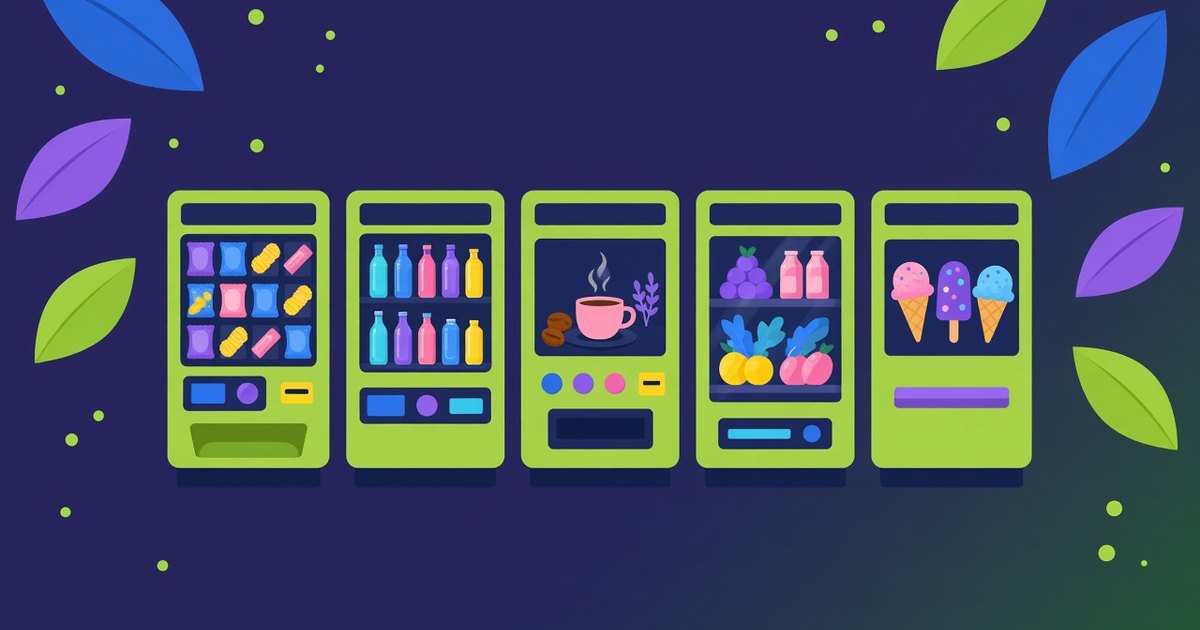
An overview of vending machine formats: from snacks and drinks to fresh food, ice cream, and unusual machines.
- Start with the need, then the format
- Snacks and drinks
- Combo machines
- Coffee and hot drinks
- Fresh food
- Coolers and lockers that open after payment
- Specialty formats
- Size and space
- Surroundings matter
- Safety and accessibility
- Payments across formats
- Service and visit frequency
- One machine or several
- What to check before you decide
- Example: a warehouse with two shifts
- FAQ
Someone at a meeting says "let's get a vending machine," and everyone nods. Fifteen minutes later it turns out one person is thinking of coffee, another of sandwiches, and a third of water for the warehouse. They are all right, they are just talking about different devices. Vending machines sell far more than candy today. The most common formats are snack, drink, coffee, and fresh food machines, alongside machines with ice cream, accessories, or local products. This post sorts out those formats, shows how they differ in day-to-day operation, and suggests the questions to ask before you pick a device for your location.
Start with the need, then the format
Choosing a format starts with a simple question: what do people at this location need, and when? Night-shift workers need something filling at three in the morning. Students between classes want a quick coffee and something sweet. Gym members want water, because they forgot their bottle again. One building can have several of these groups. Only once you know who you are serving does it make sense to talk about a device. Otherwise it is easy to choose equipment that looks good in a catalog but does not fit the rhythm of the day. Operators usually start with these questions. If yours does not, ask them yourself. The format is a tool, not a goal. The best machine is the one people actually use.
Snacks and drinks
The best-known formats. Candy, chips, bars, water, and drinks in cans or bottles. You will find them in offices, on university campuses, and at stations. A snack machine most often works with spirals. The customer picks a number, the spiral turns, and the product drops into the delivery bin. A drink machine may use spirals, columns, or another mechanism, depending on the model and the type of packaging. Both formats are relatively simple to run. The products usually have long shelf lives, so visits can be less frequent than with fresh food. That makes them a good starting point for places new to vending. The limits come mainly from package sizes and the surroundings. Strong sunlight or heat from a radiator does no favors to chocolate or drinks.
Combo machines
Can one machine sell snacks and drinks? Yes, combo machines offer both. Usually part of the unit holds spirals with snacks, and part is set aside for drinks, often in a chilled zone. It suits places that lack the space for two separate machines, or where traffic is too low to support them. The trade-off is a smaller choice in each category. A combo will not hold as many drink selections as a dedicated drink machine. For a small office or branch, that is often enough. For a large production hall, it may fall short. You can check how many selections a model has and how they are split in the maker's specs, or ask the operator.
Coffee and hot drinks
A coffee machine is a world of its own. It does not dispense finished products from a shelf. It makes the drink on the spot from coffee, powdered or fresh milk, chocolate, tea, and water. That brings different needs. The device usually needs a water connection or regular refilling of a tank. It needs cleaning, descaling, and topping up of ingredients. Customers judge it by taste, not just by whether it works. A coffee machine does well where people spend a lot of time: offices, hospitals, campuses. It often stands next to a snack machine, because coffee and something to go with it are a natural pair. The maker states installation requirements for each model, and the operator usually assesses the spot together with the building manager.
Fresh food
Sandwiches, salads, fruit, and snacks with simple ingredients. They need refrigeration and more frequent product rotation. This is the format for places where people need a meal, not just a snack. A workplace with no cafeteria, a hospital with night shifts, an office building far from restaurants. Fresh food has a short shelf life, so the operator has to visit often and remove products that are near their date. The producer gives storage conditions on the label, and keeping them in the machine is the operator's job. This format gives a lot, but it also asks a lot. If traffic at a location is low, losses on unsold sandwiches can outweigh the benefits. So before choosing it, talk about the real number of customers.
Coolers and lockers that open after payment
Vending coolers and lockers that unlock after payment are becoming more common. The customer taps a card, the door unlocks, and they pick a product from the shelf themselves. The system recognizes what was taken and charges for it. How it recognizes items depends on the model, for example shelf scales or cameras. This format can sell oddly shaped products, because nothing drops from a spiral. Glass jars, delicate pastries, local products, or larger packs fit more easily. The customer sees and handles the goods, which feels more like a shop than a classic machine. In return, the device usually takes only cashless payments. Exactly how billing works for a given model is described in the maker's documentation.
Specialty formats
Ice cream, accessories, local products, and refrigerated cabinets that open after payment. We cover them in more detail in other articles. An ice cream machine needs freezing and a well-chosen spot, because people buy ice cream differently across the seasons. An accessories machine can sell chargers, earbuds, hygiene products, or small office supplies. It works at stations, hotels, airports, and buildings where someone regularly forgets something. There are also machines devoted to one category, such as bread, heat-up meals, or healthy food. Each of these formats answers a specific need. It is rarely the first choice. It usually shows up once the basic machines are in place and someone spots a gap they do not fill.
Size and space
Every format has its own dimensions, and the space in a building does not stretch. Before deciding, measure not only the spot where the machine will stand but also the route it has to travel to get there. Doors, hallways, elevators, and stairs can be surprising. The space around the device matters too. A machine needs room to open its door for restocking, and for ventilation if it has refrigeration. The maker gives the required clearances in the manual. Then there is a power outlet, and for a coffee machine often a water connection as well. An electrician or the building manager should assess the electrical setup. It is better to measure twice than to find out on delivery day that the machine will not fit through the door.
Surroundings matter
The same machine can work well in an office lobby and struggle in an unheated hall or in a passage where the outside doors keep opening. Refrigerated units work harder in warm surroundings, and some products handle neither heat nor cold well. Machines meant for outdoor use are a separate category, with a different housing and different requirements. The maker gives the range of conditions a model can work in, in the manual or the specs. We give no values here, because they vary between devices. It is also worth thinking about sun on the glass, drafts, and whether someone turns off the heating at night. Details like these rarely make it into a catalog, and then they show up in a service report. An operator who knows similar locations will usually ask about them right away.
Safety and accessibility
A machine usually stands somewhere many people walk past. It must not block an escape route or hide a fire extinguisher or hydrant. The building manager decides where a device can stand, and the person responsible for fire safety can help if in doubt. It is also worth considering whether someone in a wheelchair or a shorter person can use the machine. The height of the keypad, reader, and delivery bin depends on the model. If accessibility matters to you, ask the operator about it and check the specs before you sign anything.
Payments across formats
How a machine takes payment depends on the device and on what the operator chooses. Classic snack and drink machines can take coins, bills, cards, and phones, often several methods at once. Coolers and lockers that open after payment usually work cashless only, because the door has to know who it is opening for. Coffee machines may have card readers, and in companies sometimes staff card or key systems. The payment choice matters to customers. Where many people pay cash, a card-only machine may sit idle. In an office where nobody carries coins, a coin mechanism may be unnecessary. The maker's specs describe which payments a given model supports.
Service and visit frequency
Formats differ in how often the operator has to come by. Snacks and canned drinks have long shelf lives, so visits depend mostly on how fast things sell. Fresh food needs frequent visits regardless of traffic, because products have to be removed as their dates approach. A coffee machine needs regular cleaning and ingredient top-ups. Coolers that open after payment are like small shops, so the operator often checks the tidiness of the shelves as well. These differences affect the operator's costs, and so the terms of the agreement. If a location is far from the operator's route or traffic is low, some formats may not pay off. It is better to hear that at the start than after a few months of empty shelves.
One machine or several
In many places, a set works better than a single device. A coffee machine next to a snack machine creates a small corner where people take care of everything at once. At a workplace, a fresh food machine for the night shift can join the snacks and drinks. In a smaller office, one combo may be plenty. The decision depends on headcount, working hours, access to other places to eat, and space in the building. We do not know your building and will not pretend to know how many machines you need. A good operator should propose a setup, explain where it came from, and agree to change it if the first weeks show something is off.
What to check before you decide
Before you choose a format or accept the operator's proposal, go through a few questions:
- who uses the machine, at what hours, and what they need most often,
- whether there are other places in the building to get food and drinks,
- the size of the spot and the delivery route, and the device's size per its specs,
- whether there is a power outlet, and for coffee a water connection, and who will check it,
- which payments will be available, and whether they suit your people,
- how often the operator will visit with the chosen format.
The answers usually point to the format on their own. If they do not, that is a sign to start with one device and watch.
Example: a warehouse with two shifts
Picture a warehouse with two shifts, where the nearest shop is a fair walk away. The manager assumes a snack machine will do. The operator asks about working hours and learns that the night shift has nowhere to get anything warm or filling. They propose a snack and drink machine in the break room and a coffee machine next to it. Fresh food is put off for later, because nobody knows how many people will buy it. After a few weeks, the report shows that at night it is mostly filling snacks and coffee that sell. The manager and the operator come back to the sandwich question, this time with data. The decision is quick, because nobody is guessing anymore.
Related reading: Vending Cooler vs. Spiral Machine.
FAQ
Which format is most common? Snack and drink machines are the most widespread.
Can one machine sell snacks and drinks? Yes, combo machines offer both.
Which format needs the most frequent operator visits? Usually fresh food, because the products have a short shelf life and need regular rotation.
Does a coffee machine need a water connection? It depends on the model. Some use a tank, others a connection. Check the maker's specs.