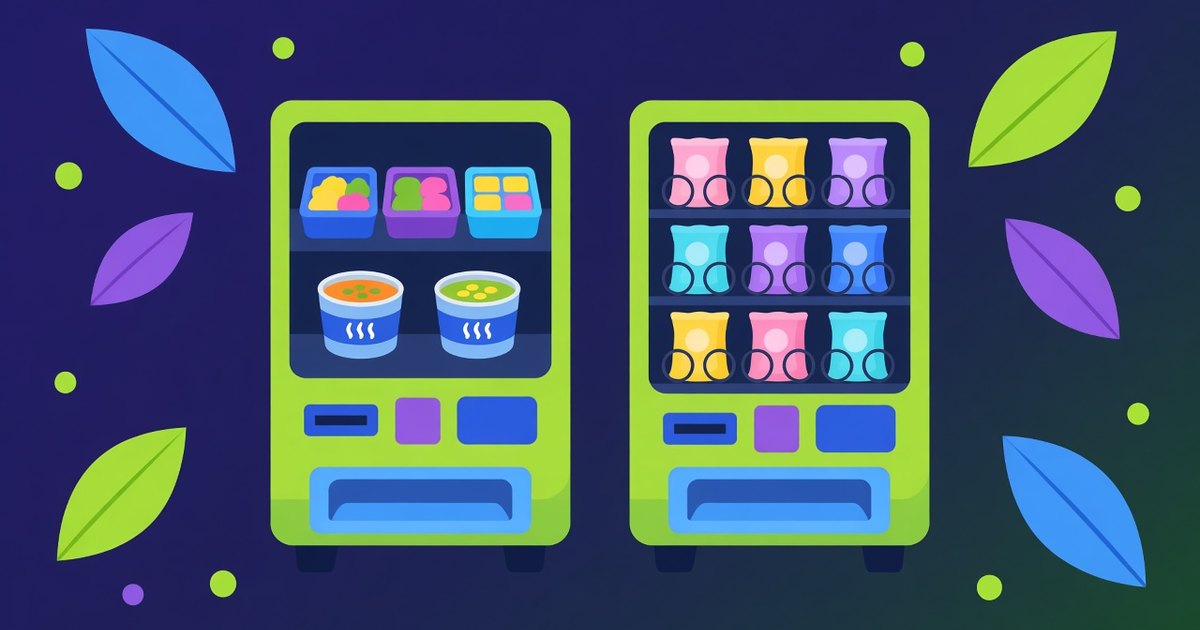
"Food vending machine" covers several different devices. Each holds a different kind of product.
- Start with the question, not the machine
- Spiral machine
- Vending cooler
- Carousel machine
- Machines with an elevator as a middle ground
- Coffee machines are a separate topic
- Snack or meal
- Heat-up meals
- Freshness and deliveries
- Hours when nobody is cooking
- How much space you need
- Packaging and waste
- Allergens and customer information
- Schools, hospitals, and other places with their own rules
- Start with a trial
- What to check before you decide
- Example: an office park on the edge of town
- FAQ
It is one o'clock, and the nearest diner is a fifteen-minute walk from the office. One person leaves for a sandwich and comes back forty minutes later, while another eats a third candy bar in a row and pretends it is lunch. In places like this, someone eventually asks about a food vending machine. A food vending machine is usually one of three devices: a spiral machine with packaged snacks, a vending cooler with sandwiches, salads, and meals, or a carousel machine with meals in containers. The right format depends on whether people need a quick snack or a full meal. This article compares these formats and shows what to ask the operator before you decide.
Start with the question, not the machine
It is easy to open a catalog and fall for the newest model. It is better to start with the people. How many work or spend time in the building? When do they eat? Is there a cafeteria, a store, or a diner nearby? Do people work shifts, including nights? Do they have a place to heat food? The answers tell you more than any spec table. In an office where most people go out for lunch, a snack machine is often enough. In a plant where the night shift has no access to anything else, a full meal is needed. An operator who knows similar places can help turn those answers into a specific format.
Spiral machine
Bars, chips, cookies, nuts, and bottled drinks. Long-shelf-life products that handle the drop into the bin. This is the best-known format. Products sit in spirals that turn after a purchase and drop the pack into the pickup area. A spiral machine is fairly simple to run, and the products keep for a long time, so the operator does not need to visit every day. It does have clear limits. It does not suit fragile products or most fresh food. Even with a chilled zone, a drop from a height does a sandwich no favors. It is a good choice when people need something quick and eat their full meal elsewhere.
Vending cooler
Sandwiches, wraps, salads, heat-up meals, yogurts, and drinks. The customer takes the item after paying. The page on vending coolers (publisher's site) has examples. A vending cooler works a bit like a store display case with a lock. The customer pays, the door unlocks, and the system recognizes what was taken. Products do not fall, so the cooler can sell fragile items and packs of different shapes. The customer sees the product up close and can read the label before buying. A cooler does need more frequent deliveries, because fresh food has shorter dates. The producer gives storage conditions on the package, and the operator is responsible for making sure the unit meets them.
Carousel machine
Meals in containers and delicate items, served through a door instead of dropped. In a carousel machine, products sit on rotating shelves. After a purchase, the carousel turns until the chosen product reaches the door, and the customer takes it out. This format works well for meals in containers, desserts in cups, and products that must not tip over. The customer gets exactly the product they chose and has no access to the rest. A carousel usually holds less than a cooler of a similar size, but it controls better what leaves the machine. The manufacturer's spec sheet lists which container sizes it accepts.
Machines with an elevator as a middle ground
Between a spiral machine and a cooler, there is one more option. It is a spiral machine with an elevator, a mechanism that lowers the product into the pickup area instead of dropping it. That lets the machine sell products a regular one would damage, such as yogurts, glass bottles, or some sandwiches in rigid packs. The customer still has no access to the inside, so there is no risk of taking two items instead of one. The elevator needs regular service, and dispensing may take a little longer. The manufacturer's spec sheet tells you whether a model has an elevator and which products it can handle. It is a good compromise where a cooler will not fit.
Coffee machines are a separate topic
A coffee machine does not sell food, but it often stands next to a food machine and shapes the choice. Someone buying a sandwich often wants coffee or tea with it. If there is already a good coffee machine on site, the food machine can focus on meals and snacks. If not, it is worth planning a whole corner. Two machines side by side need more space, power, and service access. The manufacturer gives the required clearances between devices and from the wall in the manual. Also check with the building manager that the chosen spot has a suitable outlet and that the line will not block the walkway.
Snack or meal
The difference between a snack and a meal seems obvious, but in vending the line is blurry. A candy bar and chips are snacks. A sandwich can be a snack or a light meal, depending on its size and on who is eating it. A meal in a container is a meal, though it often needs heating. Before you choose a format, think about the role the machine should play. Should it add to the cafeteria or replace it? Should it be a backup food source for the night shift, or a daily lunch spot for half the office? The answer decides whether a spiral machine is enough, or whether you need a cooler or a carousel.
Heat-up meals
Does vending food need heating? Some meals do – the producer says so on the package. If the machine will hold heat-up meals, there has to be a place nearby to heat them. Usually that is a microwave in the kitchen or break room. Sometimes the operator suggests a microwave as part of the corner. Agree up front who is responsible for it, who cleans it, and who checks that it works. A microwave that nobody cleans quickly puts people off buying hot meals. The producer gives heating instructions and times on the package. We give no temperature guidance here, because it depends on the product.
Freshness and deliveries
The fresher the food, the more often the operator has to visit. A spiral machine with candy bars can be restocked less often, because the products have long dates. A cooler with sandwiches and salads needs more frequent visits. The operator has to bring new products and remove those near their date. How often that happens depends on sales, the products, and the agreement. The site host should know how often the operator plans deliveries and what happens to products that do not sell. That matters when judging whether a format makes sense at all in a given place. A cooler with empty shelves, or with products near their date, puts people off faster than having no cooler.
Hours when nobody is cooking
A food machine often matters most when everything else is closed. The cafeteria runs at lunchtime, the store closes in the evening, and the night shift works until morning. If the machine has to cover those hours, the plan should reflect it. Products have to last until the next delivery, and the operator needs to know that peak demand comes at, say, two in the morning. A sales report broken down by hour helps make that visible. The site host can ask the operator for this data. It makes it easier to judge whether the chosen format really helps the people who need it most.
How much space you need
Each format has its own requirements. A spiral machine and a cooler are often similar in width but differ in depth and in how the door opens. A cooler with an outward-opening door needs room in front of it. A carousel may be narrower but taller. On top of that comes space for the technician, who has to open the door and swap products. The manufacturer gives dimensions and required clearances in the spec sheet. Do not judge by eye. Measure the spot, check the width of the doors the machine has to pass through, and ask the building manager about floor load if the machine is going on an upper floor of an older building.
Packaging and waste
Every vending meal leaves packaging behind. A sandwich comes in film or cardboard, a meal in a plastic bowl with a lid, a salad in a cup with a fork. With a meal cooler, the amount of waste grows quickly. Plan for it in advance. Is there a trash can next to the machine, or better, several bins for sorting? Who empties them? Sorting rules depend on the building and local regulations, so settle them with the building manager. A full trash can next to the machine looks worse than the machine itself. People soon stop eating in a spot where there is nowhere to throw away a container.
Allergens and customer information
With vending food, the customer cannot ask a clerk about ingredients. They have to rely on the label. In a cooler or carousel, they usually see the product up close. In a spiral machine, the label may be hidden behind the glass or turned away. Some machines have a screen with a product description. In that case, the description should come from the label. The producer is responsible for the label, and the operator for having the right product in the right place. We do not cover food labeling rules here, because that is a regulatory area. If a customer asks about ingredients, point them to the label, and to the operator if in doubt.
Schools, hospitals, and other places with their own rules
In schools, the range is limited by rules on food for children and teenagers. We do not list what is allowed, because that depends on current regulations. The school management knows the rules, and the operator should choose the range to match them. Hospitals and other facilities may have internal rules, for example about where a machine can stand or when deliveries can happen. Settle them with the administration before choosing a format. Sometimes a cooler cannot stand in a hallway while a spiral machine can. Sometimes it is the other way around. Better to know before signing the agreement than after the machine arrives.
Start with a trial
Not every decision has to be final. If you are not sure people will buy full meals, ask the operator about a trial period or about changing the range after a few weeks. A cooler with sandwiches and meals can start with a small selection and grow from there. A spiral machine can get a few selections with more filling snacks. A sales report is a better basis for a decision than a survey in which everyone claims they will eat salads. The agreement sets the terms of such a trial, so ask about them before signing.
What to check before you decide
Before you choose a food vending format, go through a few questions:
- whether people need a quick snack or a full meal, and at what times,
- whether there is a cafeteria, store, or diner nearby,
- whether there is a place to heat meals, and who is responsible for it,
- how often the operator plans deliveries of fresh products,
- how much room there is for the machine, the door, and service, per the spec sheet,
- whether the site has its own food rules, such as a school or hospital.
Discuss the answers with the operator. A good operator will ask you similar questions before suggesting anything.
Example: an office park on the edge of town
Picture an office building on the edge of town, where the nearest restaurant is across a busy road. Employees have a snack machine, but more and more of them complain that there is nothing to eat for lunch. The office manager talks to the operator. The operator suggests a vending cooler with sandwiches, salads, and heat-up meals next to the spiral machine. The manager checks the spot and the outlet with the building manager and puts a second microwave in the kitchen. For the first few weeks, the operator watches sales and adjusts the mix. Heat-up meals sell faster than salads, so they get more space. Employees stop making forty-minute trips for a sandwich.
FAQ
Which format is best for meals? Vending coolers and carousel machines are more common for full meals.
Does vending food need heating? Some meals do – the producer says so on the package.
Can a spiral machine sell sandwiches? It is usually not the best choice, because the sandwich drops into the bin. A cooler, or a machine with an elevator or carousel, works better.
Who decides what food goes into the machine? The operator, together with the site host and in line with the agreement and any rules that apply at the site.