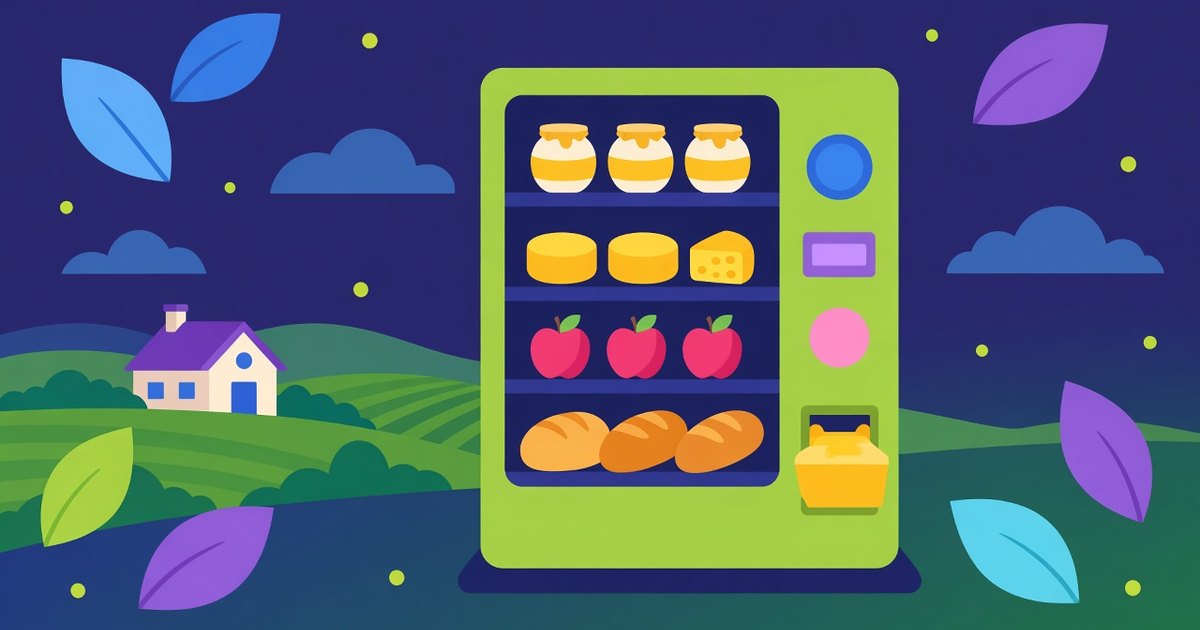
Local producers' goods can make a machine stand out. They must meet the same requirements as any other product.
- Local does not mean simpler
- What to check
- The label speaks for the producer
- Device format
- Shelf life and storage
- Deliveries, the weakest link
- Price and viability
- What happens to unsold stock
- Who is responsible for what
- A trial, not a revolution
- How to tell the product's story
- Where it makes sense
- What to check before you decide
- Example: honey from an apiary outside town
- FAQ
Someone at the office brings in pastries from the bakery around the corner, and fifteen minutes later only crumbs are left. Someone else asks why the machine never has juice from the orchard down the road. It is a good question, but the answer takes more than one sentence. Local products can be sold through vending if their packaging fits the device, they have a full label, and their shelf life allows for sale. This post covers what to check with the producer, which device format makes it easier, how to plan deliveries and a trial, who is responsible for what, and what to ask the operator before local cheese ends up next to the candy bars.
Local does not mean simpler
A product from nearby earns goodwill. Customers like knowing where something comes from, and the host is happy to support a neighbor. To the machine, though, it is just a product that has to meet the same conditions as stock from a wholesaler. It has to fit, it needs a label, and it has to last the time between delivery and sale. The difference is that a large producer usually designs packaging for retail, while a small one designs it for their own shop or market stall. A jar with a handwritten sticker looks great on a stall. In a machine, it can be a problem. The point is not that local products are unsuitable. The point is that they need checking just as carefully, sometimes more carefully, before they join the range.
What to check
Before a product goes into a machine, it is worth running through a short list. Each item rules out a different kind of trouble:
- Sturdy packaging that fits the device.
- A full label with ingredients and allergens.
- Shelf life and storage conditions.
- Regular deliveries from the producer.
Packaging decides whether the product can be sold without damage at all. The label decides whether the customer knows what they are buying. Shelf life and storage conditions tell you whether the product will last until it sells. Regular deliveries decide whether the selection stands empty for half the month. If any item raises a doubt, it is better to clear it up with the producer and the operator before launch than after the first complaint.
The label speaks for the producer
In a shop, a customer can ask the clerk whether the cake has nuts in it. At a machine, there is nobody to ask. So all the information has to be on the pack, legible and complete. Ingredients, allergens, the date mark, storage conditions, and the producer's details are what customers look for most often. Which information is mandatory for a given product comes from food information rules, and meeting them is the producer's responsibility. We will not list the requirements here, because they depend on the type of product and business. If a label looks incomplete or hard to read, ask the producer to explain. The operator may also have its own list of requirements for suppliers. It helps when both sides agree on this in writing before the first crate reaches the warehouse.
Device format
Coolers and lockers can sell oddly shaped products. The page on vending coolers (publisher's site) has examples. In a spiral machine, a product has to drop from the shelf into the delivery bin. Flat, rigid packs handle that well. A glass jar, a delicate cake, or an irregular bag can jam or get damaged. In a cooler or locker, the customer opens the door after paying and takes the product out, so nothing drops. That makes room for items that would be a risk in a spiral. Every device still has its own shelf and compartment sizes. You can check how much space a product will take in the device manual, or by trying it on site with the operator.
Shelf life and storage
Local products often have simple ingredients and a shorter shelf life than their mass-produced counterparts. That can be a plus for the customer and a challenge for the machine. Time passes between delivery and sale, and a machine does not mark products down on its own as the date approaches. The operator needs to know how much time there is to sell, and to set the visit frequency and the number of units to match. The producer gives storage conditions on the label. If a product needs chilling, it has to go into a device that provides it, and keeping those conditions is the operator's job. We do not give temperatures or dates here, because they depend on the product. All of this should be on the pack, and the producer answers any open questions.
Deliveries, the weakest link
A large wholesaler delivers on a fixed schedule. A small producer may have one van, one oven, and a summer vacation. That is not a criticism, just reality. If a product sells well and then disappears for two weeks, customers lose interest fast. Before launch, agree with the producer how often they can deliver, in what quantities, and what happens if they cannot make it. Sometimes the answer is delivering to the operator's warehouse instead of the machine itself. Sometimes it is better to pick a product with a longer shelf life that tolerates less frequent deliveries. The operator usually knows how to fit the restocking route to what the producer can manage. It also helps to have a backup on the shelf, so an empty selection is not the only answer to a missed delivery.
Price and viability
Are local products more expensive? It depends on the product and producer. Small-scale production often means a higher unit cost, but not always. The vending price also has to cover the operator's costs: transport, restocking, losses on expired units, and a commission for the host if the agreement includes one. We give no amounts or margins here, because every case is different. The more important question is whether customers at that location will pay a price that covers those costs. In an office where people value quality, that may come naturally. In a place where every cent counts, the local product may sit untouched next to a cheaper candy bar. A trial gives the answer, not a hunch or enthusiasm at a meeting.
What happens to unsold stock
Every product with a date mark sooner or later leaves a few units nobody bought. With wholesale stock, the operator usually has set rules for this. With a small producer, those rules still have to be agreed. Do unsold units go back to the producer, or does the operator write them off as a loss? Who decides when a product has to come off the shelf? Does the producer accept returns, and if so, how quickly? There is no single right answer to these questions. What matters is that an answer exists before the first batch passes its date. Otherwise a dispute over a few jars can spoil a partnership that started well. It is best to write these points into the agreement or a simple message both sides confirm. The operator knows the rules for disposing of food, and the building manager can help if in doubt.
Who is responsible for what
Local products make it easy for things to blur, because three parties are involved. The producer is responsible for the product, its ingredients, its label, and meeting the requirements for their business. The operator is responsible for the device, storage conditions in the machine, rotation, and removing expired units. The host provides the space and often has a say in the range. Does a local producer need special documents? Requirements depend on the business and product. The producer should know and meet them, and the operator can ask for confirmation before starting to work together. If you as the host recommend a specific supplier, pass the contact to the operator and let them do their own checks. You do not need to know the rules. You only need to know who is supposed to.
A trial, not a revolution
Start with a few products and check sales after a few weeks. Swapping half the machine for local products overnight is a recipe for losses and disappointment. It is better to pick two or three items that fit the device most easily and watch how they sell. The sales report will show whether customers come back for a product or bought it once out of curiosity. It is also worth gathering feedback, for example with a short note by the machine or a message to the team. After the trial, it is easier to decide whether to expand the range, swap the product, or go back to the old layout. Any of those decisions is fine. A trial that ends with "this does not work" is still a successful trial.
How to tell the product's story
A customer at a machine has a few seconds. If a local product sits between familiar brands, it is easy to miss. A short note about where it comes from can help, as long as it is true and matches what the producer says. A sticker by the selection, the machine screen, or a poster nearby only needs the producer's name and town. Avoid promises that cannot be checked, such as "the healthiest" or "the best in the region." Descriptions of a product's properties, health ones for instance, are an area covered by rules. It is safer to stick to facts from the label and agree on the wording with the producer and the operator. Sometimes the simplest message works best. "From the bakery on the next street" says more than a long description.
Where it makes sense
Local products usually do well where customers come back every day and have time to grow fond of something. Offices, workplaces, campuses, hospitals, and multi-tenant buildings give them that chance. Regulars learn when deliveries happen and ask about their favorites. In places people pass through, such as a station, customers more often reach for what they know. That does not mean it will not work there, only that the trial may take longer. The character of the place matters too. A company that is proud of its ties to the local community may want to show that in the machine as well. A school has its own food rules that limit the choice. An operator who knows the location can help judge whether the idea suits the people who spend time there.
What to check before you decide
Before you ask the operator for local products or agree to their proposal, go through a few questions:
- whether the packaging fits the device and will survive the way products are dispensed,
- whether the label is complete and legible, and what the producer says if in doubt,
- what the shelf life is and whether it fits the operator's visit frequency,
- whether the producer can deliver regularly, and what happens if they cannot,
- who checks the producer and their documents,
- how long the trial will run, and how you will judge whether it worked.
A short note with the answers will help you come back to what was agreed in a few weeks, when it is time to decide.
Example: honey from an apiary outside town
Picture an office building where a few people ask for honey from an apiary just outside town. The office manager passes the contact to the operator. The operator finds that the jar will not work in a spiral, but it fits in the vending cooler in the lobby. The label has ingredients and the producer's details, and the shelf life is long, so less frequent deliveries are not a problem. The producer confirms they can bring a larger batch to the operator's warehouse every so often. One selection goes in to start. After a few weeks, the report shows the honey sells slowly but steadily, and a handful of people buy it regularly. The operator keeps one selection and does not expand the range. Nobody announces a revolution. A few people simply have their favorite honey within reach.
Related reading: Package Sizes in Vending and Snack Vending Machines.
FAQ
Does a local producer need special documents? Requirements depend on the business and product. The producer should know and meet them.
Are local products more expensive? It depends on the product and producer.
Which machine works best for local products? Usually a vending cooler or locker, because the product does not drop from a shelf. Check compartment sizes in the device manual.
How many products should we start with? A few. After a few weeks, the sales report will show what is worth keeping.