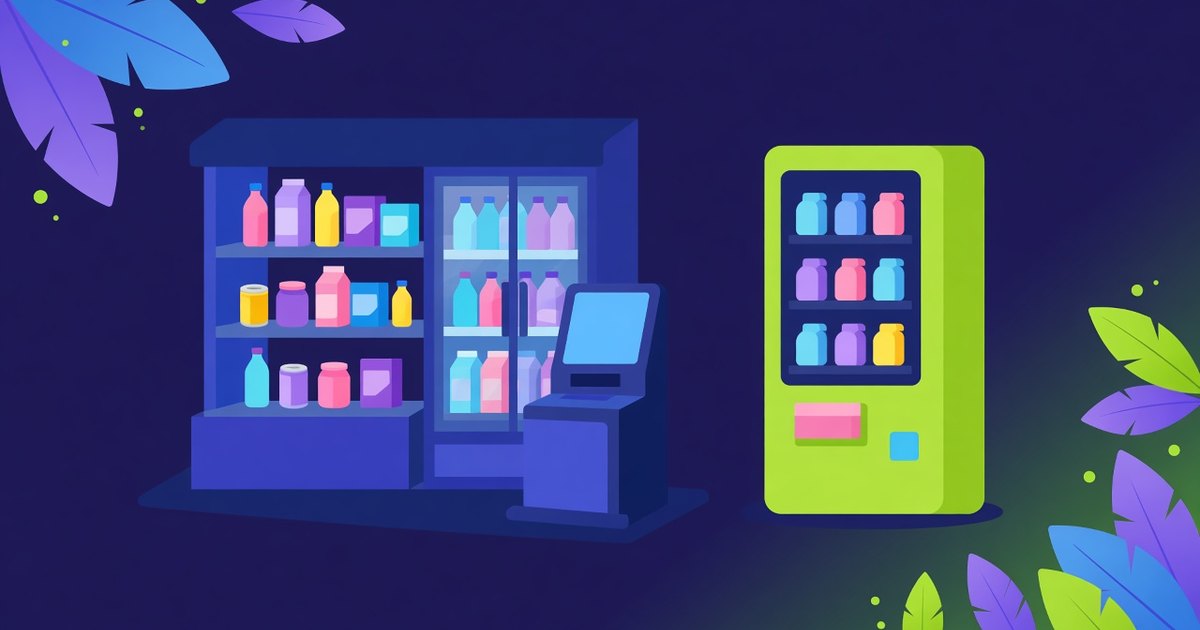
How a micro market differs from a vending machine: selection, space, payments, and who each format suits.
- Two different ideas of self-service
- Selection: shelves versus spirals
- Space and access
- Payments: scan versus select
- Trust is part of the equipment
- Upkeep and refills
- Fresh food changes the rhythm
- Starting small is an option
- Which format fits which place
- They can work together
- What to check before you decide
- Example: the floor with a spare room
- FAQ
Someone in your office has seen a micro market at a friend's company. Open shelves, a fridge with salads, a screen where you scan and pay. Now the question lands on your desk: should we get one too, or stick with a vending machine? A micro market is a small self-service store with open shelves and a payment kiosk, while a vending machine is a closed unit that dispenses after payment. A micro market needs more space and a trusted group of users. This post compares the two formats on selection, space, access, payments, upkeep, and daily life, so you can decide which one fits your building instead of the building next door.
Two different ideas of self-service
Both formats let people buy without a cashier. That's where the similarity mostly ends. A vending machine keeps everything behind glass or a door. The customer chooses, pays, and the machine hands over one product. Nothing leaves the cabinet unless it has been paid for first. A micro market works the other way around. Products sit on open shelves and in fridges. The customer picks them up, carries them to a kiosk, scans them, and pays. The store trusts people to scan what they take. That one difference shapes everything else: where each format can stand, who can use it, how much space it takes, and what can be sold. Keep it in mind as you read the rest of the comparison.
Selection: shelves versus spirals
A micro market holds more products, including fresh ones. Open shelves and fridges can take items of almost any shape: a salad bowl, a bag of fruit, a yogurt, a sandwich, a bottle of juice. A vending machine has fewer selections but takes little space. Each spiral or slot holds one kind of product, and its size has to fit the mechanism. That limits the range, but it also keeps things simple. People know where to look, and the operator knows what to refill. If your team wants variety and fresh food every day, a micro market gives more room to play with. If they want a coffee, a drink, and a snack within a few steps, a machine often covers it. The exact range in either format depends on the operator's offer.
Space and access
A micro market works in closed offices with access control. A vending machine can also stand in public areas. That's not a matter of taste. Open shelves only make sense where the people walking past are a known group, such as employees with access cards. In a lobby open to visitors, a station, or a school corridor, unpaid products would simply walk out. A vending machine doesn't have that problem, because it hands out nothing before payment. Space is the other side of it. A micro market needs a small room or a clear corner with shelves, fridges, a kiosk, and space for people to move between them. A machine needs a spot along a wall, a socket, and room to open its door. Measure before you dream.
Payments: scan versus select
In a micro market, customers scan products at a kiosk. At a vending machine, they pay before the product is dispensed. Both can usually take cards and phones, and the exact options depend on the payment system the operator uses. The difference is in the flow. At a kiosk, a person may scan several items in one go, which suits a lunch with a drink and a dessert. At a machine, each selection is usually a separate purchase, which suits a quick snack between meetings. A kiosk also asks more of the customer. They have to remember to scan everything. Most people do, of course. But the whole format depends on that habit, and on the operator's way of handling the occasional honest mistake.
Trust is part of the equipment
It sounds strange to list trust next to fridges and kiosks, but in a micro market it really belongs there. The format assumes that people scan what they take. In a stable office team that usually works. People know each other, they come back every day, and nobody wants to be the person caught walking away with an unscanned yogurt. In a place with a lot of strangers, visitors, or temporary staff, the picture changes. That's why operators often look at who will use the space before they suggest a micro market. Some add cameras or other measures. If they do, the building manager and the person responsible for data protection should be part of the conversation. A vending machine sidesteps the question entirely, which is part of its charm.
Upkeep and refills
Both formats need regular visits, but the work looks different. A vending machine is refilled selection by selection, following its layout plan. The operator checks products, cleans the cabinet and the delivery bay, and collects data from the controller. A micro market is more like a tiny shop. Shelves need tidying, fridges need checking, labels and prices need to match what is on the shelf, and the kiosk needs attention too. Fresh products need closer care, and how they are handled is set by the products' labels and the operator's procedures. None of this falls on you as the host, as long as the agreement says so. But it's worth knowing that a micro market usually means more frequent or longer visits, and the operator will plan around that.
Fresh food changes the rhythm
Fresh products are the main reason people ask about micro markets. They are also the reason the format needs more attention. A sandwich or a salad has a shorter life on the shelf than a bag of chips. That means the operator has to plan smaller, more frequent deliveries and keep an eye on what is left. How long a product may be sold and how it must be stored are written on its label, and the operator's procedures follow from there. We won't add rules of our own. For you, the practical effect is simpler. A micro market with fresh food tends to change from day to day. Some days the favorite salad is gone by noon. That's normal, and good feedback to the operator helps more than a complaint in the team chat.
Starting small is an option
If you're not sure about a micro market, you don't have to bet the whole kitchen on it. Many places start with what they already have and add one thing at a time. A machine can stay where it is while the operator tests a fridge with a few fresh items in a secured area. Or a micro market can begin with a narrow range and grow once people get used to scanning. Starting small lets you see how your team actually behaves, instead of guessing in a meeting. Ask the operator whether a trial period or a smaller setup is possible, and what would change in the agreement if you expand later. Then judge by what people buy, not by what they said they wanted.
Which format fits which place
There is no single winner. Which format is better for an office depends on headcount, space, and access control. A small team in a shared building with a busy lobby will often be better served by one or two machines. A larger team in its own secured floor, with a free room near the kitchen, may get more out of a micro market. Shift work, visitors, and opening hours matter as well. Think about who will use it at night, who comes from outside, and whether the space is locked after hours. If you're unsure, ask the operator to describe similar places they serve and what worked there. Their experience is more useful than any general rule, ours included.
They can work together
You don't always have to choose. Micro markets and vending machines can work together, for example a coffee machine next to a micro market. The machine handles hot drinks, which open shelves can't, and the micro market handles fresh food and variety. In some buildings a machine also stands in a public area, while the micro market sits behind access control for employees only. That way visitors still have something to buy, and the team gets a bigger range. Mixing formats means more coordination, so it helps when one operator handles both. Otherwise you may end up with two contracts, two service numbers, and two sets of people asking where the milk went.
What to check before you decide
Before you choose a format, go through a short list:
- how many people will use it, and at what times,
- whether the space is closed to the public and has access control,
- how much room you have, including space for people to move around,
- where the sockets are and whether an electrician should look at them,
- what range people actually want: quick snacks, coffee, or full meals,
- which payment methods the operator's system supports,
- how often the operator plans to visit and what each visit includes,
- who handles problems, refunds, and complaints,
- whether cameras or other measures are planned, and who has approved them.
If an answer is missing, note the question and ask the operator before signing.
Example: the floor with a spare room
Picture a company that rents one floor of an office building. Everyone enters with a card, and there's a small room next to the kitchen that used to hold printers nobody misses. For years, a single snack machine stood in the corridor. It worked, but people kept asking for something more substantial at lunch. The office manager talks to the operator. They look at headcount, the locked floor, and the spare room. The suggestion is a micro market in that room, with the existing coffee machine kept in the kitchen. Visitors on the ground floor still have the vending machine in the lobby, run by the building. Lunch gets easier, coffee stays where it was, and the old printer room finally earns its keep.
Related reading: Vending Cooler vs. Spiral Machine and Food Vending Machines.
FAQ
Which format is better for an office? It depends on headcount, space, and access control.
Can they work together? Yes, for example a coffee machine next to a micro market.
Can a micro market stand in a public lobby? Usually that's not a good fit, because open shelves need a known group of users. A vending machine suits public areas better.
Does a micro market need more space? Yes. It needs room for shelves, fridges, a kiosk, and people moving between them.