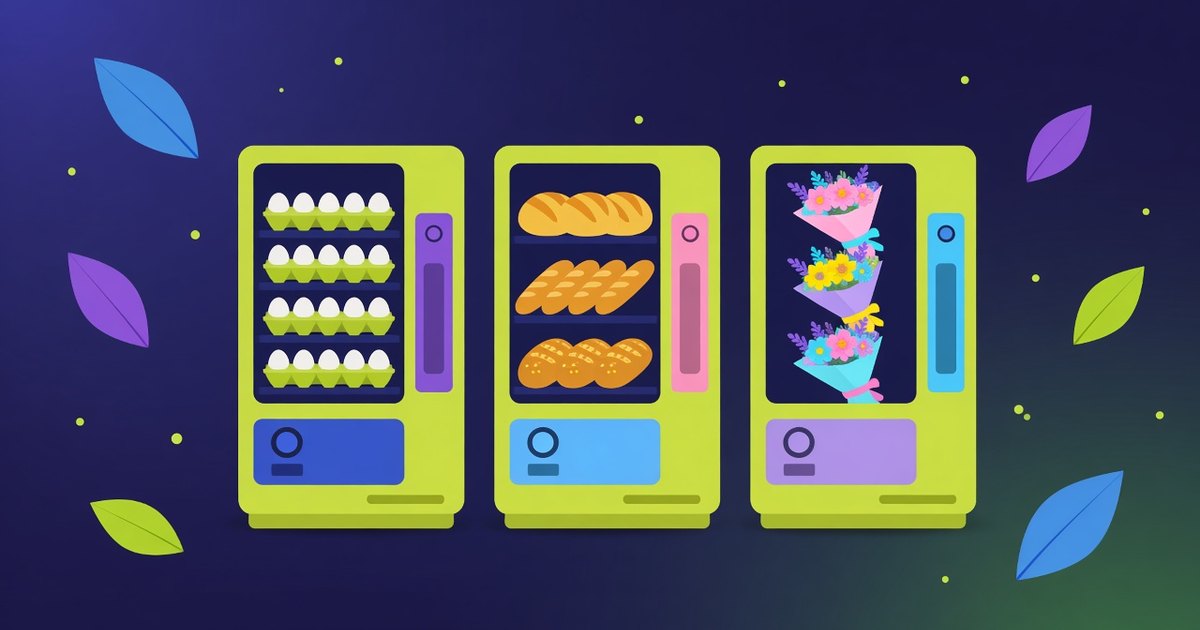
Machines selling eggs, bread, flowers, and local products – the unusual vending formats you can find in Poland.
- Why producers sell through machines
- Farm products by the road
- Bread after the bakery closes
- Flowers near cemeteries and stations
- Pet food, bait, and other surprises
- What these machines need
- Outdoors is harder than indoors
- Who is responsible for freshness
- Paying at a machine in the countryside
- Where to put the machine
- Cleaning and small repairs
- Example: eggs by the gate
- What to check before you decide
- FAQ
You drive past a farm on a country road and notice a small cabinet by the gate. It is not a mailbox. It sells eggs. A few kilometers later, in town, a bakery is closed for the night, but a machine next to its door still offers bread. Near a cemetery, another one sells flowers. Snacks and drinks are what most people picture when they hear "vending machine," but in Poland machines sell many other things. This post walks through the most common unusual ones, who usually runs them, what they need to work well, and what to think about before you put one by your own gate or door.
Why producers sell through machines
Most unusual machines don't belong to large vending operators. They often belong to the people who make the products. A farmer with laying hens, a small bakery, a florist, or a local cheese maker. For them, a machine solves a simple problem. Customers want to buy at times when nobody can stand behind a counter. Early in the morning, late in the evening, on a Sunday. A machine sells while the producer works, sleeps, or simply has a day off. It also lets them sell directly, without a shop in between. That doesn't mean a machine is effortless. Someone still has to fill it, clean it, and deal with problems. It just moves the work to hours that suit the producer.
Farm products by the road
Eggs are probably the best-known example. A machine by the farm gate holds cartons in separate compartments, and customers pay and open the right door. Similar machines can sell milk, cheese, honey, vegetables, or fruit. Some stand at the farm, others in nearby towns where more people pass by. Many of these products need cooling, so the machine has to keep the right temperature. Which temperatures and which rules apply depends on the product. Food rules are not something to guess. A producer planning such sales should check the requirements for their products with the relevant authorities or an advisor. We don't describe those requirements here, because they depend on the product and the type of business.
Bread after the bakery closes
A bread machine lets people buy a loaf after the bakery has closed. For someone who comes home late from a shift, that can be the difference between fresh bread and none. The baker fills the machine before closing time, and it sells through the evening or the night. Some machines also hold rolls, buns, or pastries. What sells well depends on the place and the customers. A machine next to the bakery door makes sense, because people already know where to find bread. Freshness matters a lot here. Bread that sat in a machine since morning is not what anyone hopes for at nine in the evening. The baker decides how often to refill and what to remove, and the customers quickly notice the difference.
Flowers near cemeteries and stations
Flower machines are often found near cemeteries, train stations, and hospitals. These are places where people sometimes need flowers at a moment when the shop is closed. Someone on the way to visit a grave early in the morning. Someone at the station who suddenly remembers an anniversary. A flower machine has to protect delicate products, so it is usually cooled. Bouquets sit in separate compartments, each visible through a window. The florist who runs the machine decides what goes inside and how often it is refreshed. Cut flowers don't last forever, and a wilted bouquet in the window is not good advertising. We describe flower machines in more detail in a separate post on this blog.
Pet food, bait, and other surprises
Beyond eggs, bread, and flowers, the list goes on. Some machines sell pet food near parks or housing estates. Others sell fishing bait near lakes and rivers, which is handy for anglers who start before dawn. There are machines with phone accessories, hygiene products, or small everyday items. Some sell books, others toys or local souvenirs. The selection depends on local needs and on what the person running the machine can supply. A machine with fishing bait in the middle of a city center would probably sell very little. The same machine by a popular fishing spot may do much better. With unusual machines, the place often matters more than the product itself.
What these machines need
An unusual machine still needs the basics. It needs power, usually from a socket the right distance away. An outdoor machine needs a connection suitable for outdoor use, and an electrician should decide how to do it. It needs a stable, level spot where it won't tip over or get hit by a car backing out. Many machines need cooling, which means the right ventilation around the cabinet. The machine's manual says how much space it needs. It also needs a payment method that customers actually use. A machine that only takes coins can be frustrating when nobody carries them anymore. Cards need a reader and usually a connection. Each of these is simple on its own. Together they decide whether the machine works.
Outdoors is harder than indoors
Many unusual machines stand outside: at a farm gate, by a bakery door, near a cemetery entrance. That brings its own challenges. Rain, frost, and direct sun all affect the machine and the products inside. A machine designed for indoor use may not cope with weather. Manufacturers usually say whether a model can stand outside and what conditions it tolerates. A roof or a shelter can help. So can a spot out of the afternoon sun. Outdoor machines are also more exposed to vandalism and theft. Good lighting and a visible location often help more than any lock. A machine tucked away in a dark corner is convenient for exactly the wrong people.
Who is responsible for freshness
Customers sometimes ask whether products from unusual machines are fresh. The answer depends on the person running the machine. They decide how often to refill, what to remove, and how to check the products. A producer who fills the machine every day knows what went in and when. A machine visited once a week is a different story. For products with a shelf life, the producer's label tells customers what they need to know. The machine's temperature also matters, which is why many have cooling and some have temperature monitoring. If something seems wrong with a product, customers should contact the person who runs the machine. A clear sticker with contact details makes that easy.
Paying at a machine in the countryside
Payments are a practical question, especially outside cities. Coins and banknotes work without any network. Card readers usually need a connection, often over a mobile network. In some rural spots, the signal is weak. A card reader that keeps failing will frustrate customers more than a machine with no card option at all. It helps to check the signal at the planned spot before installing a reader. Phone payments and other methods depend on the reader and the payment provider. Many producers keep both cash and cards, so that a customer always has a way to pay. The machine's signs should say clearly which methods work. Nobody enjoys finding that out after choosing a carton of eggs.
Where to put the machine
For a producer, the obvious spot is next to the farm, bakery, or shop. That has advantages. Customers already know where to go, and refilling is easy. Sometimes a better location is elsewhere, though: a busy road, a town square, a parking lot near a station. A spot on someone else's property needs that owner's agreement. In public spaces, other formalities may apply. A property manager, the local office, or a lawyer can say what is needed in a specific case. We don't describe those rules here. It is also worth thinking about access. Customers need a safe place to stop, and the person refilling the machine needs to reach it with a full crate.
Cleaning and small repairs
A machine that sells food has to stay clean. Crumbs from bread, a cracked egg, or water from wet flowers can end up inside the compartments. Left alone, they attract insects and leave a smell nobody wants near their dinner. The person running the machine should plan regular cleaning, not just refills. The manual usually says how to clean the compartments and which products are safe to use. Small faults happen too. A door that doesn't open, a coin that gets stuck, a reader that freezes. Some can be fixed on the spot. Others need the manufacturer's service. It helps to know in advance who to call, before the first customer is standing in front of a locked door.
Example: eggs by the gate
Picture a small farm on the edge of a village. The owners used to sell eggs from their kitchen door. Customers came at all hours, sometimes during dinner. They decided to put a cooled egg machine by the gate. It holds a number of cartons in separate compartments. The owners refill it every morning and check it again in the evening. A small roof protects it from rain, and a lamp lights it at night. The machine takes coins and cards, after a quick check confirmed the signal was good enough. Customers now buy eggs whenever they want. The family eats dinner in peace. The chickens didn't notice anything.
What to check before you decide
If you are thinking about selling your own products through a machine, go through a short list:
- whether the product suits machine sales and what conditions it needs,
- which requirements apply to selling it, checked with the relevant authorities or an advisor,
- whether the machine is designed for the place you have in mind, indoors or outdoors,
- how power will reach it, decided by an electrician,
- which payment methods customers in that place really use,
- who will refill and clean the machine, and how often,
- how customers can contact you if something goes wrong.
An unusual machine can be a good way to reach customers at odd hours. It works best when the product, the place, and the person behind it fit together.
Related reading: Unusual Vending Machines Around the World and Book Vending Machine.
FAQ
Who runs these machines? Often local producers or small businesses that want to sell directly to customers.
Are the products fresh? That depends on the person running the machine, who is responsible for freshness and refills.
Can such a machine stand outdoors? Only if the manufacturer says the model is suitable for it. Power outdoors should be connected by an electrician.
Do I need permission to sell food from a machine? Requirements depend on the product and the business. Check them with the relevant authorities or an advisor.